


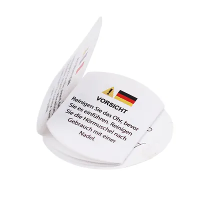


Foldable RFID tags mainly consist of three parts: an antenna, a chip, and a substrate. The antenna typically uses flexible conductive materials, such as flexible printed circuits, metal foil, conductive ink, or fabric antennas. The chip is connected to the antenna via a flexible substrate, such as polyimide (PI) or PET. The substrate can be made of flexible materials such as paper, plastic film, fabric, or polymers.
When the tag approaches the reader, the reader emits high-frequency electromagnetic waves. The tag's antenna receives these waves and generates an induced electromotive force to power the chip. Once activated, the chip modulates the stored data onto the electromagnetic waves and transmits it back. Folding may cause changes in antenna parameters, but communication stability can be maintained through optimized design.
Technical implementation includes flexible circuit design, such as flexible printed circuit boards with serpentine or mesh wiring. Mechanical structure optimization involves using indentation lines or flexible hinges at the folding points to mitigate structural weaknesses. Material selection involves choosing conductive inks, ultra-thin metal foils, and substrate materials with high elongation at break.